Last Updated: November 5, 2026
Quick Summary
The best structured cabling contractors in Oregon prove their qualifications in writing: state low-voltage licensing, verifiable insurance, manufacturer certification, named installer credentials, and comparable references. Ask each bidder how they will qualify the installation for the manufacturer warranty and what test documentation they deliver at closeout.
- A complete scope covers design, pathways, installation, testing, labeling and closeout records.
- Category 6 handles most endpoints, while Category 6A supports higher throughput and longer runs.
- Extended manufacturer warranties depend on certified installation and passing test results submitted to the manufacturer.
- Cost is driven by labor, pathways, ceiling access, after-hours work, testing and documentation, not cable.
- Have at least two contractors walk the building and put their findings in writing before you commit.
Table of Contents
- Why the Contractor You Pick Decides How Your Network Performs
- What a Commercial Structured Cabling Contractor Should Handle
- Network Cabling Contractor Qualifications That Actually Matter
- Structured Cabling Project Planning: What a Real Proposal Includes
- When You Need a Fiber Optic Cabling Contractor
- What Drives Cost, and How to Compare Bids Fairly
- Schedule a Free Site Walk Before Your Next Cabling Project
- Frequently Asked Questions
Why the Contractor You Pick Decides How Your Network Performs
The cabling crew that shows up first and quotes lowest is rarely the one you want pulling cable through your building.
Network slowdowns at predictable times of day and cameras that drop offline in the same spot are common problems in commercial buildings.
Below, we break down seven questions that separate a commercial structured cabling contractor who will still answer your call in year five from one who disappears after the invoice clears. Ask them before you sign anything.
What a Commercial Structured Cabling Contractor Should Handle
A commercial structured cabling contractor should own the full path from design to documentation: cabling design, pathways, installation, testing, labeling, and closeout records your IT team can actually use.
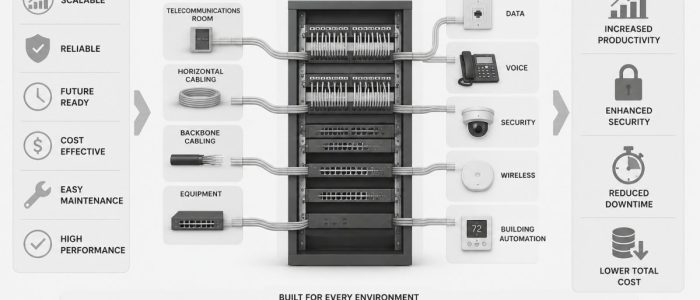
That scope matters because a cabling system is not one product. It is a set of standards-based subsystems that have to work together.
A credible scope of work covers:
- Structured cabling design tied to your floor plans, equipment rooms and growth plans
- Network and data cabling installation for workstations, servers, switches and wireless access points
- Testing and certification of every run, with results delivered to you
- Cable organization and labeling that matches your documentation
If a bid skips design or closeout documentation, it is not a complete scope. It is a partial one with your name on the risk.
Copper, Fiber and the Systems That Ride on Both
Most buildings need both copper and fiber, and the choice is a design decision, not a preference. Category 5 cabling is largely legacy at this point. Category 6 cabling handles most office, classroom and clinic endpoints well.
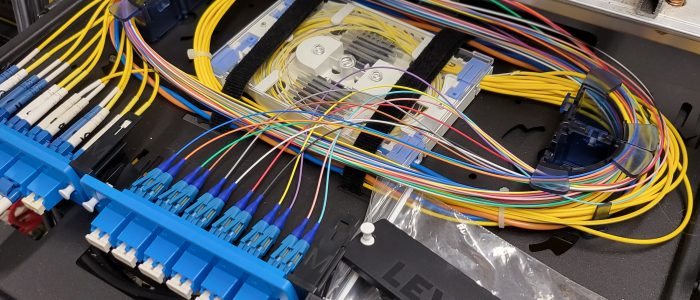
Fiber-optic cabling covers the backbone: building-to-building links, long interior runs, and connections between media centers, servers and core switches. Copper cabling and fiber are not competitors.
Network Cabling Contractor Qualifications That Actually Matter
Licenses and insurance are a starting point when evaluating a cabling contractor. Other qualifications can also indicate how well a cabling system will perform over time, and they are verifiable if you know what to request.
The Credentials Worth Asking For
Structured cabling is governed by published standards, and a contractor’s familiarity with them shows up in the paperwork more than the sales pitch. The two you will hear referenced most often are the ANSI/TIA-568 series, which covers commercial cabling design and performance, and the BICSI installation and design credentials that many commercial crews hold.
Ask for:
- State contractor licensing appropriate to low-voltage work, plus a certificate of insurance you can verify with the carrier
- Manufacturer certification for the cabling system being proposed, since extended warranties usually depend on it
- Installer credentials such as BICSI or equivalent, with names attached to the crew that will actually be on site
- References from comparable projects, ideally the same building type and scale as yours
A common pattern is a contractor who holds certification through a manufacturer but cannot produce the individual installer records that the warranty program requires. The company credential and the crew credential are not the same thing.
The Warranty Question Is Really a Design Question
Extended manufacturer warranties on a cabling system typically depend on two things: certified installation and passing test results submitted to the manufacturer (Verification Qualification and Certification). That means the warranty is not a promise the contractor makes after the fact. It is a design and documentation requirement baked into the project from the start.
When you compare contractors, ask each one to describe, in writing, how they will qualify the installation for the manufacturer’s warranty program and what test documentation they will hand over at closeout. A contractor who cannot answer that question may leave you with a system that performs fine today and has no coverage tomorrow.
Watch out: a warranty certificate that arrives without the underlying test records is difficult to enforce. Request both together.
Test Documentation You Should Expect at Closeout
Every run should be tested, and the results should be delivered to you in a format your IT team can open and use. For copper, that usually means per-run test reports showing the run passed the chosen category’s performance requirements.
If a proposal describes testing as “tested on site” without naming the standard, the tester, or the deliverable, treat that as an open question rather than a completed scope item.
Why the Lowest Bid Is Rarely the Cheapest
Rework, retesting and premature replacement usually cost more than the difference between bids. A crew that skips certification, tests loosely, or leaves documentation incomplete shifts the cost of fixing those gaps onto you, often years later when the original crew is gone.
For a deeper look at how to vet a crew before you sign, see our guide to hiring reliable Oregon network contractors.
Structured Cabling Project Planning: What a Real Proposal Includes
A real proposal names the cable categories, the pathway routes, the testing standard, the labeling scheme and the closeout deliverables.
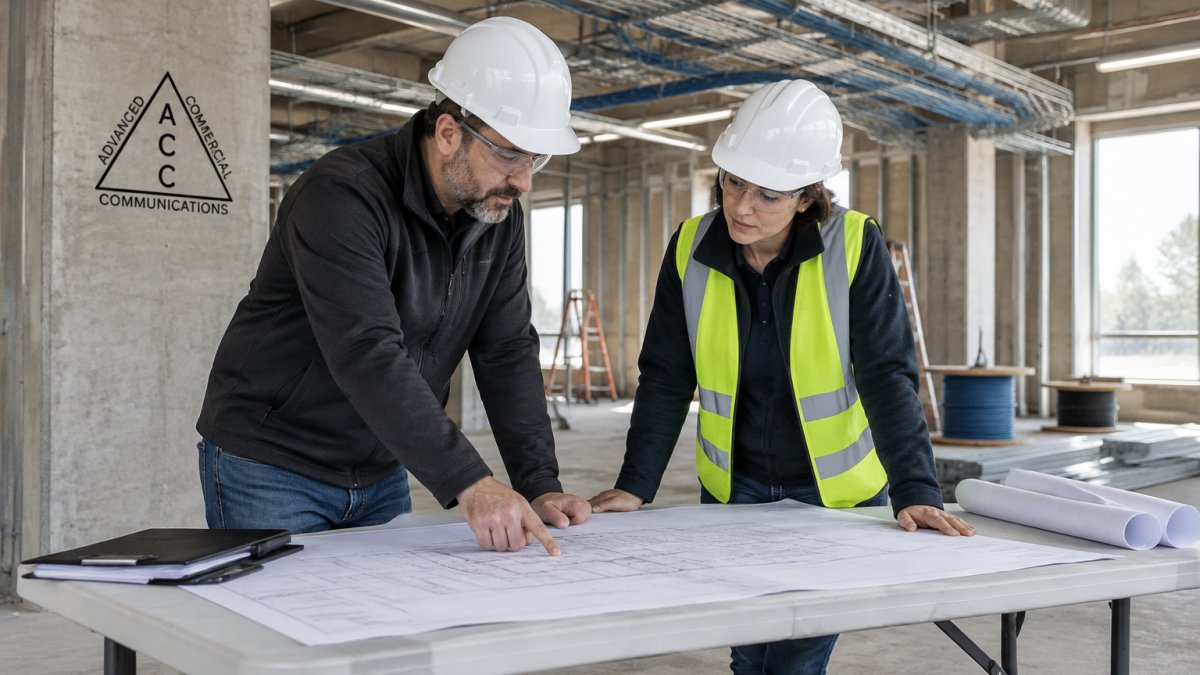
A proposal worth comparing includes:
- A scope narrative tied to specific areas, not “the building”
- Cable categories and counts by area
- Pathway and cable routing approach, including how existing infrastructure is reused
- Testing and certification method
- Labeling and documentation standards
Structured cabling project planning is where you find out whether the contractor has actually looked at your building.
For a concrete example of what a professional scope looks like, our structured cabling design service page walks through the design phase in detail.
When You Need a Fiber Optic Cabling Contractor
You need a fiber optic cabling contractor when distance, bandwidth or separation between buildings makes copper impractical.
The tradeoff is real. Fiber typically costs more upfront than copper and requires different termination skills and test equipment.
Watch out: fiber is where unqualified crews show up most often. Poor polishing, dirty connectors and undocumented splices produce intermittent failures that are expensive to trace.
What Drives Cost, and How to Compare Bids Fairly
Cost in a structured cabling project is driven by scope, not by the cable itself. Cable is a small share of the total. Labor, pathways, ceiling access, after-hours work, testing and documentation drive the number, and those variables are exactly what a vague proposal hides.
The Variables That Move the Number
Understanding what drives cost helps you read a bid instead of just comparing totals.
- Cable category and count. Category 6 and Category 6A cable cost more per foot than legacy Category 5, and the count of runs by area sets the material and labor baseline. A bid that says “Cat6 throughout” without counts is not a bid you can compare.
- Pathway and routing. Whether cable runs through existing trays and conduit or requires new pathways is often the largest labor variable. Reusing existing infrastructure lowers cost; opening walls or adding conduit raises it.
- Ceiling and access conditions. Open ceilings, hard-lid ceilings, occupied spaces and historic buildings all change how long a run takes. Access conditions are a schedule and labor driver, not a footnote.
- After-hours and occupied-space work. Work in an active office, clinic or school often has to happen outside business hours, which affects labor cost and scheduling.
- Testing and certification. Per-run testing and documentation take time and equipment. A bid that prices testing as an afterthought is pricing an incomplete scope.
Pricing depends on quantity, access conditions and schedule, so be skeptical of any contractor who quotes a firm number before walking the site. A site walk is what turns a guess into a scope.
How to Compare Two Bids Side by Side
Here is how we would line up two proposals against each other:
| What to Compare | Why It Matters | What a Weak Bid Looks Like |
|---|---|---|
| Cable category and counts | Defines performance and material cost | “Cat6 throughout” with no counts |
| Pathway and routing plan | Biggest labor variable | Silent on how cable gets there |
| Testing and certification | Proves the system meets spec | “Tested on site” with no records |
| Labeling and documentation | Determines maintainability | Not mentioned |
| Schedule and after-hours work | Affects labor and disruption | No milestones listed |
| Exclusions and assumptions | Prevents change orders | Blank or vague |
| Warranty terms | Protects your investment | Standard language only |
The table is a reading tool, not a scorecard. A bid that answers every row in writing is easier to compare than one that answers none, even if the second bid is lower on paper.
The Change-Order Trap
Vague proposals are where change orders come from. If a bid does not state what is excluded, every surprise during the project becomes a negotiation. Ask each contractor to list their assumptions explicitly, including what they assume about existing pathways, ceiling access and after-hours constraints.
For budget context on what drives network infrastructure upgrade costs, see our breakdown of the cost of upgrading business network infrastructure, and for fiber specifically, our guide to fiber optic installation costs for businesses.
Schedule a Free Site Walk Before Your Next Cabling Project
A site walk turns a guess into a scope.
Advanced Commercial Communications is a veteran-owned, Oregon-based low-voltage and network infrastructure company. We provide free site walks and consultations to tailor solutions to your facility and budget.
When you are ready to stop guessing about what is in your walls, request a site walk and we will walk the building with you.
Frequently Asked Questions
What does a structured cabling contractor actually do?
A structured cabling contractor designs, installs, tests and documents the low-voltage cabling system that carries data, voice, video and wireless traffic through a building. That covers cable routing and pathways, patch panels, jacks, fiber backbones, wireless access point cabling and labeling. The work also includes certification testing and closeout documentation so your IT team or a future vendor can trace and maintain every connection. For Oregon organizations, the right contractor also coordinates with your IT staff, general contractor and other trades so cabling is in place before walls close.
How do I choose a structured cabling contractor for a business?
Start with a free site walk so the contractor can see the building rather than bid from a drawing. Ask for a written scope that names cable categories, fiber type, testing method and closeout documents. Verify insurance, licensing and references on projects similar in size and industry to yours. Confirm who performs the work and who handles warranty calls after installation. Finally, ask how change orders are priced, because renovations rarely match the original plan exactly. A contractor who answers these plainly before you sign is usually the one who answers the phone after.
Can structured cabling support security cameras and access control?
Yes. Modern security cameras, access control readers and door controllers run over the same low-voltage cabling infrastructure as your data network, often with Power over Ethernet supplying both connectivity and power. That makes cabling design a security decision, not just an IT one. Camera resolution, recording retention and reader placement all depend on adequate cable runs and switch capacity. Planning cameras and access control during the cabling phase usually costs less than retrofitting later, especially in new construction or a full renovation.
How long does a commercial cabling project take?
Timelines depend on square footage, cable volume, whether the space is occupied and how much pathway work is needed. A single-floor office refresh may take days, while a multi-building campus with fiber backbone and new construction can run weeks or longer alongside other trades. The bigger variable is scheduling: cabling has to land before ceilings close and after electrical rough-in. Ask your contractor for a phased plan that shows when each area is disrupted, so staff and operations can plan around it.
The difference between a network that ages well and one that fights you for a decade usually comes down to the questions asked before the contract. Start with a walkthrough, get the scope in writing, and compare bids on the details that actually drive cost. Get started with Advanced Commercial Communications and turn your cabling project into infrastructure you can document, maintain and build on.