Table of Contents
- Why Oregon Network Contractors Matter for Your Project
- What Oregon Network Contractors Actually Do: Service Scope and Specialties
- Oregon Licensing and Compliance Requirements for Network Contractors
- Questions to Ask a Cabling Contractor Before You Sign
- Your Network Cabling Contractor Checklist: Evaluating Reliability and Fit
- Network Cabling Installation Cost: What Drives Your Quote
- Conclusion: Choosing the Right Partner for Your Network Project
- Frequently Asked Questions
Last Updated: October 7, 2026
Why Oregon Network Contractors Matter for Your Project
Hiring reliable Oregon network contractors is the difference between a network that hums along for a decade and one that mystifies your IT team with intermittent failures. Oregon’s construction and specialty-trade job market keeps expanding, and demand for skilled low-voltage workers has grown right along with it. This guide from Advanced Commercial Communications covers what these contractors actually do, how state licensing works, what to ask before signing, and how quotes get built. Below, we’ll show you exactly how to separate the contractors who document their work from the ones who disappear after the final invoice.
The stakes are higher than most facility managers assume. A single mislabeled cable run can cost your team hours of troubleshooting every time something fails.
What Oregon Network Contractors Actually Do: Service Scope and Specialties
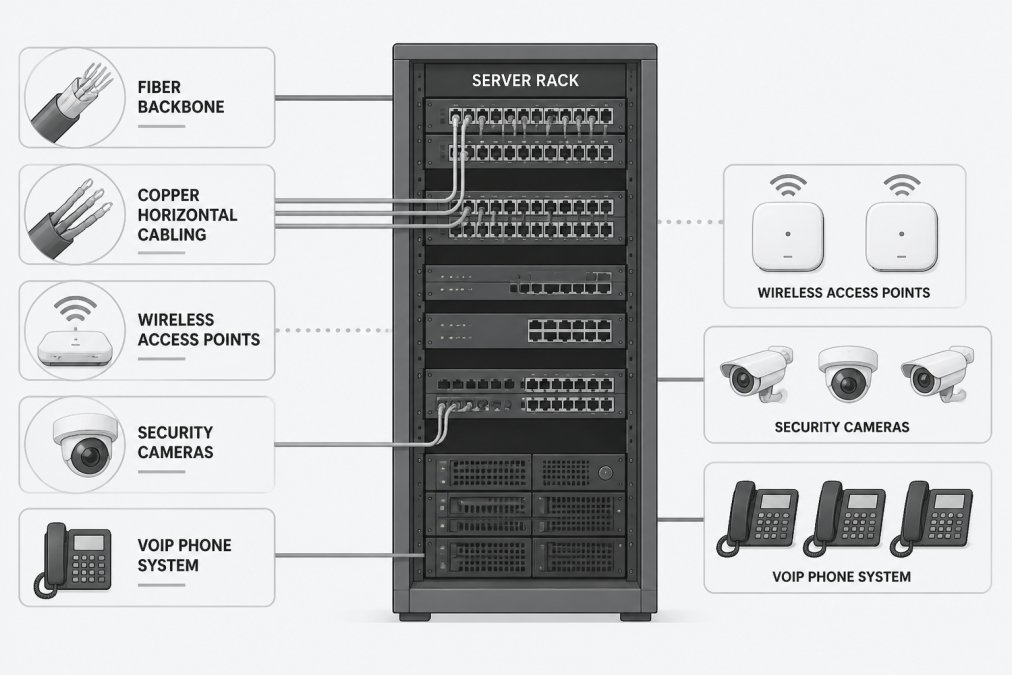
Oregon network contractors design, install, test, and certify the physical layer that carries your data: structured cabling, fiber optic runs, wireless access points, security cameras, and the pathways and racks that hold everything together. The work splits into distinct specialties, and most firms are stronger in some than others.
Common service categories include:
- Structured cabling for offices, clinics, schools, and warehouses
- Fiber optic installation and splicing for campus and inter-building links
- Wireless design and access point placement for full coverage
- Security camera and access control systems
- Paging, intercom, and mass notification
- Audio visual and conference room systems
- Managed IT and VoIP phone service on top of the cabling
The practical difference between a general low-voltage electrician and a true network infrastructure contractor shows up in testing and closeout. Ask whether they certify copper runs and provide fiber test results. If the answer is vague, keep looking.
Oregon Licensing and Compliance Requirements for Network Contractors
Most competing pages treat licensing as a footnote. For network infrastructure work, it is the first filter that determines who can legally bid your project, and getting it wrong can void insurance and force a re-inspection. Here is how the requirements actually break down.
Who regulates what. Electrical and low-voltage work in the state is overseen by the Building Codes Division within the Department of Consumer and Business Services. The division issues licenses, maintains the public license lookup, and enforces continuing education and bonding requirements. Anyone advertising network cabling, fiber, or security system installation should appear in that lookup under a valid, current license.
The license classes that matter for network work.
- Limited Energy Technician (LEA/LEB), the class most often used for low-voltage systems such as structured cabling, fire alarm, HVAC controls, and communications circuits under the voltage and power limits defined in the state electrical specialty code. Class A covers more scope than Class B; confirm which class the contractor holds and whether it matches your project.
- Supervising Electrician / Journeyman Electrician, required when the work involves line-voltage power, new electrical circuits feeding equipment, or anything the code classifies as general electrical rather than limited energy.
- General and Specialty Contractor (CCB) license, separate from the electrical license and issued through the Construction Contractors Board. Oregon contractors need both the electrical credential and a CCB number.
Bonding and insurance. Electrical contractors carry a surety bond as a condition of licensure, and the bond amount scales with the license class. Separately, ask for a certificate of insurance showing general liability and workers’ compensation. A common pattern is that the certificate lists the carrier, policy number, effective dates, and additional-insured language, if yours does not, request an updated one before mobilization.
Verify, don’t trust. The state lookup is free and takes about a minute per contractor. Check three things: the license status is active, the class matches the scope you are buying, and the business name on the license matches the name on the quote. Subcontractors on your job need the same check, a licensed prime does not automatically mean licensed subs.
Scope-specific compliance. Work in K-12 schools, healthcare facilities, and public buildings adds layers: background checks for anyone on site, fingerprinting in some districts, fire-rated penetration standards, and in healthcare, infection-control and above-ceiling work rules. Contractors who work in these environments routinely already have the paperwork ready. Contractors who do not will add weeks to your schedule.
Permits. Permit requirements vary by jurisdiction, project scope, and the systems being installed. Determine early whether permits, plan review, inspections, or licensing requirements apply to the work. Confirm who is responsible for obtaining permits, coordinating inspections, providing required drawings or documentation, and paying associated fees. Do not assume a permit is or is not required based solely on the project type. If the owner, general contractor, or another trade states that no permit is required, document that direction in writing and verify the requirement with the applicable authority having jurisdiction before proceeding.
Questions to Ask a Cabling Contractor Before You Sign
The best predictor of a smooth project is how a contractor answers questions before the contract, not after. Here are the questions that separate prepared firms from order-takers:
- Are you licensed and insured in Oregon, and can you provide the numbers?
- Will you perform a free site walk before quoting?
- What testing and certification do you provide at closeout?
- Who is my point of contact during and after the project?
- What warranty covers the installation, and for how long?
- How do you handle change orders and unexpected conditions?
- Can you provide references from similar facilities?
A contractor who hesitates on testing documentation or warranty terms is telling you something. Listen.
Your Network Cabling Contractor Checklist: Evaluating Reliability and Fit
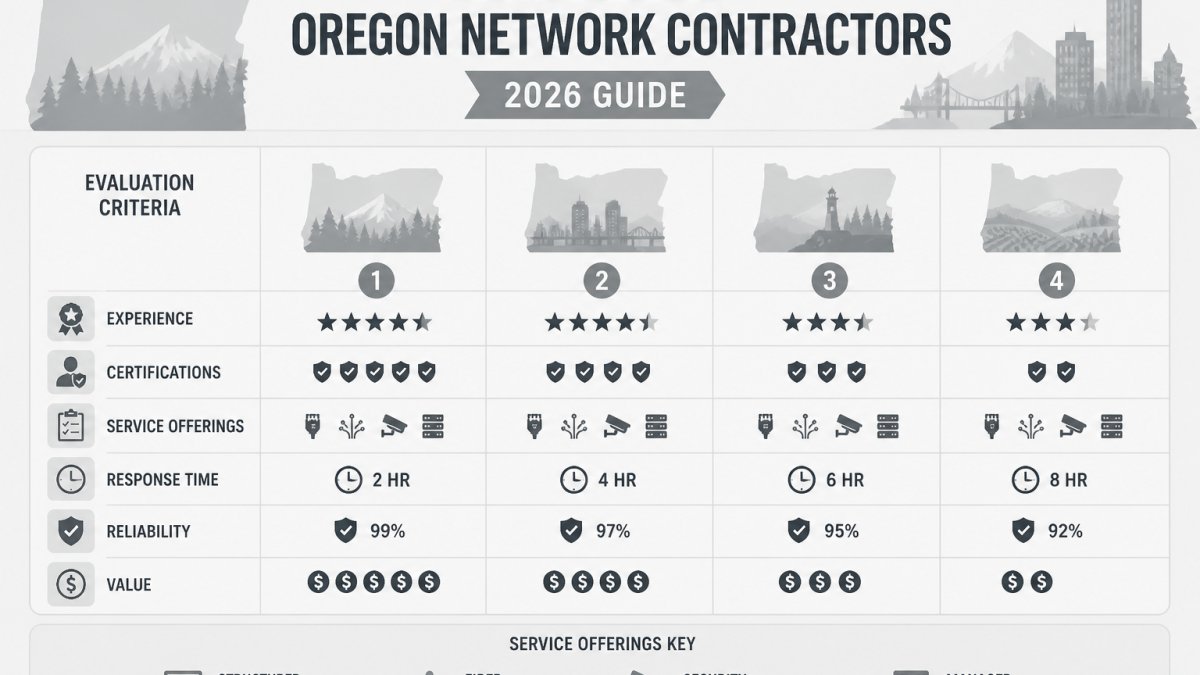
A checklist only helps if you know what a bad answer looks like. Score each contractor on the items below, then weight the categories. In practice, documentation and testing history predict reliability better than price, references, or years in business.
Category 1, Credentials (weight: high)
- Active license verified directly with the state, class matching the scope
- CCB number on file if the project includes construction scope
- Certificate of insurance showing general liability and workers’ comp
- Bond current and in the amount required for the license class
Category 2, Process (weight: high)
- Free site walk completed before any number is quoted
- Written scope listing cable categories, counts, pathways, and drop locations
- Testing and certification spelled out, copper certification and fiber test results at closeout
- As-built documentation, labeling scheme, and rack elevations promised in writing
- Change-order process described before the contract, not after
Category 3, Track record (weight: medium)
- References from at least two facilities similar to yours in size and use
- Willingness to describe a project that went wrong and how it was resolved
- Named project manager and a direct line, not a general dispatch number
- Warranty terms in writing, with the coverage period stated
Category 4, Fit (weight: medium)
- Service area covers your site with a stated response window
- Crew size and availability match your schedule, including after-hours if needed
- Familiarity with your building type, office, warehouse, clinic, school, data center
- Post-install support process described, including who answers the phone in year two
How to score it. Give each box a pass or fail. A contractor who fails any item in Category 1 is disqualified, no exceptions. A contractor who fails more than one item in Category 2 is a schedule risk. A contractor who fails Category 3 or 4 items is a fit question, not a reliability question, and you can weigh those against price.
What a bad answer sounds like. “We’ll figure out testing at the end.” “The license is under our other company.” “References are confidential.” “We don’t do site walks for small jobs.” Each of these is a signal, and in a competitive bid the contractor who answers all four cleanly is almost always the safer choice, even at a higher number.
Network Cabling Installation Cost: What Drives Your Quote
Network cabling installation cost depends on cable type, run length, ceiling and wall conditions, and how much testing and documentation you require. No honest contractor quotes from a phone call. A free site walk is the only way to price the work accurately.
Key cost drivers:
- Cable category and fiber type (higher categories and fiber cost more per run)
- Building conditions (open ceilings are fast; finished walls and occupied spaces are slow)
- Run count and distance (volume and length both matter)
- Pathways and conduit (new pathways add labor)
- Testing and certification level
- After-hours or phased scheduling to avoid disrupting operations
At Advanced Commercial Communications, we provide free site walks and consultations, then build quotes around your actual budget and facility rather than a generic per-drop number. For current pricing on your specific project, request a quote through our network infrastructure services page.
Conclusion: Choosing the Right Partner for Your Network Project
The hardest part of hiring Oregon network contractors isn’t finding someone who can pull cable. It’s finding a partner who documents the work, stands behind it, and answers the phone two years later when something needs attention. Advanced Commercial Communications is a veteran-owned, Oregon-based team that handles structured cabling, fiber optics, security cameras, and managed IT for businesses, schools, and agencies across the state. We start every project with a free site walk and build solutions that fit your budget and facility. Talk to an expert and get your network project moving.
Frequently Asked Questions
How do I find a reliable network cabling contractor in Oregon?
Start by verifying the contractor holds a current Oregon low-voltage license and carries general liability and workers’ compensation insurance. Ask for references from projects similar to yours, ideally within the past 12 months. Request a written scope that includes cable type, testing procedures, and closeout documentation. For multi-site or complex projects, prioritize contractors with demonstrated regional coverage across Oregon’s major cities. A free site walk, like the one Advanced Commercial Communications offers, lets you assess their professionalism before committing.
What qualifications should a low-voltage contractor have?
A qualified low-voltage contractor should hold an active Oregon license for limited-energy work, carry liability and workers’ comp insurance, and have manufacturer certifications for the cabling and hardware they install. Ask about their experience with structured cabling standards, fiber termination, and testing equipment. Technicians who hold BICSI or equivalent credentials bring documented expertise. For healthcare, education, or municipal projects, confirm they have worked in occupied facilities and understand the compliance requirements specific to those environments.
How can I compare quotes for structured cabling work?
Compare quotes line by line, not just the bottom number. Check whether each proposal specifies cable category and brand, jack and patch panel types, testing scope (certification vs. continuity), and whether labor for pathway installation is included. A low quote that omits testing or uses unspecified materials will cost more later. Ask each contractor to break out materials, labor, and testing separately. Also confirm what warranty covers the installation and how long it lasts. Request a detailed proposal rather than a verbal estimate.
What warranty should a network cabling contractor provide?
A standard installation warranty covers workmanship for at least one year, with manufacturer warranties on materials often extending 15 to 25 years when the installer is certified. Ask whether the warranty covers both labor and materials, and whether it transfers if you sell the building. Get the warranty terms in writing before work begins. Also clarify response times for warranty calls. A contractor who disappears after the install leaves you paying twice for the same fix, so confirm their post-installation support process upfront.