Table of Contents
- Why Fiber Optic Installation Costs Are Hard to Pin Down
- Commercial Fiber Optic Installation Cost Factors
- How to Read a Fiber Optic Installation Estimate for Businesses
- Fiber Optic Installation Project Timeline
- Fiber Optic Cabling vs. Copper for Businesses
- Building and Campus Installation Scenarios
- Recurring Service vs. One-Time Construction Costs
- Comparing Quotes: What to Ask Before You Sign
- Frequently Asked Questions
Last Updated: October 21, 2026
Why Fiber Optic Installation Costs Are Hard to Pin Down
Ask five providers for a fiber optic installation quote and you may get five different structures. That is not because one is hiding something.
An owner may receive a single number, assume it covers everything, then discover later that trenching, conduit, or network electronics were never in scope.
This guide breaks down what actually drives commercial fiber optic installation cost, how to read an estimate line by line, and what to ask before you sign.
Commercial Fiber Optic Installation Cost Factors
Four categories drive nearly every fiber project budget: route distance and site conditions, labor, materials and installation method, and permitting and right-of-way. Understanding how each one is priced lets you sanity-check a proposal before it reaches your CFO.
Route Distance and Site Conditions
Distance is the most obvious cost driver and the least predictable. A fiber cable run across an open field is straightforward. The same run through a downtown block with buried utilities, mature trees, and active traffic control is a different job entirely. Site conditions also affect feasibility. Older buildings may lack spare conduit or pathway space, so the project needs new sleeves, penetrations, and firestopping.
How Labor Is Priced
Installation labor is typically the largest single line item, and it is usually estimated in one of two ways.
Labor rates also vary with prevailing wage requirements on public work, crew size, and whether work happens after hours to avoid disrupting operations. Union and non-union labor markets differ, and public-sector projects often carry wage determinations that change the math.
Materials and Installation Method
Fiber cable itself is rarely the dominant cost. The cable, connectors, splice enclosures, patch panels, and innerduct are modest compared with the labor and construction around them. What moves the number is the method.
- Aerial installation uses existing utility poles and strand. It usually avoids trenching and restoration, so it is often the lower-cost outside method when poles are available and accessible.
- Buried installation requires trenching or directional boring, conduit, and restoration of pavement or landscaping. Directional boring reduces surface disruption but carries its own equipment cost.
- Indoor installation avoids excavation entirely but is driven by pathway conditions, ceiling access, and after-hours labor.
A useful way to frame early budgeting is cost per foot or cost per mile of route, but treat those figures as planning ranges rather than quotes.
Permitting and Right-of-Way
Permitting and legal overhead cover right-of-way agreements, easements, utility coordination, and municipal encroachment permits. A route crossing private property needs an easement. A route crossing a public street needs a permit and possibly traffic control. These costs are real and often underestimated, and they scale with the number of jurisdictions a route touches.
Existing Infrastructure
Existing infrastructure cuts both ways. Spare conduit and available rack space reduce cost. Missing pathways, full cable trays, or undersized telecom rooms add it. A site walk is the only reliable way to know which situation you have.
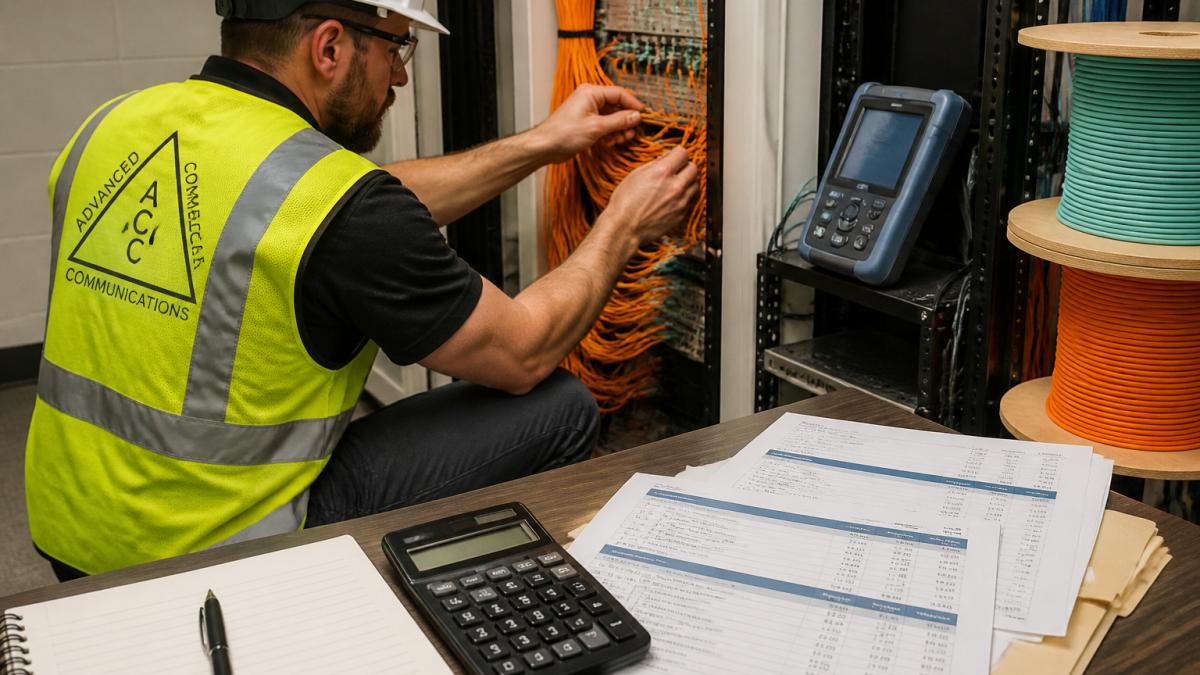
Ask your provider to walk the route with you before quoting. A route walked on foot surfaces conduit blockages, inaccessible poles, and locked utility vaults that a desk-based estimate will miss. That single walk often prevents the change orders that blow up budgets later.
How to Read a Fiber Optic Installation Estimate for Businesses
A business fiber optic installation estimate should separate four distinct cost buckets: construction, inside-building installation, network equipment and commissioning, and recurring service. Most disputes happen when these get blended into one lump sum.
Here is the itemization structure we recommend requesting:
| Cost Bucket | What It Should Cover | Why It Matters |
|---|---|---|
| Outside construction | Trenching, conduit, aerial strand, restoration, permits | Highest variability; confirm what is included |
| Inside installation | Fiber cable runs, termination, patch panels, testing | Often quoted separately from outside plant |
| Equipment and commissioning | Switches, optics, testing, labeling, documentation | Frequently excluded from construction quotes |
| Recurring service | Monthly internet access or lit fiber service | Operating cost, not capital expenditure |
A quote that lists only construction leaves you to source equipment and commissioning elsewhere. A quote that lists only monthly pricing describes a service contract, not a construction project. Both are legitimate.
The most common mistake is comparing a construction quote against a service quote as if they were the same thing. One is a capital expenditure you own; the other is an operating cost you rent. Comparing them side by side without separating the categories can lead to bad decisions.
Fiber Optic Installation Project Timeline
Timelines follow the same pattern as budgets: the physical work is often the shortest phase. Design and permitting usually take longer than installation itself.
A typical commercial project moves through site survey and design, permitting and right-of-way approval, construction, and finally testing and commissioning. Permitting is the wildcard.
Plan for the schedule to be driven by approvals, not by crew availability.
Fiber Optic Cabling vs. Copper for Businesses
Fiber optic cabling differs from copper in capacity, distance, and immunity to electromagnetic interference. Single-mode fiber carries signals across long distances without the signal degradation copper experiences.
The tradeoff is capital versus longevity. Copper costs less to install for short distances, but fiber supports far higher bandwidth and does not need replacing when speeds increase.
According to the Fiber Broadband Association’s industry resources, fiber infrastructure is built for multi-decade service life, which changes the return on investment calculation.
The right question is not “fiber or copper” but “which segments of my network need which.” Most well-designed commercial networks use both, with fiber on the backbone and copper at the edge.
Building and Campus Installation Scenarios
Most commercial fiber projects fall into a handful of patterns, and they price very differently. The point of walking through them is not to hand you a number. It is to show which cost categories appear in each case so you can build a budget that holds up.
Single Office or Tenant Space
A hypothetical mid-size office needs fiber from the building’s demarcation point to a new telecom room two floors up. The work is indoors: pathway installation, cable pulls, termination, testing. No trenching, no right-of-way. Cost is driven by labor hours, pathway conditions, and cable length. The dominant variables are after-hours access and whether spare conduit exists.
Multi-Tenant Building
The distance from the provider’s demarcation point to each tenant matters here. One tenant near the entry point and another on the far side of the building face different runs, and a shared riser may or may not have capacity. Budget line items include riser pathway, per-tenant drops, a shared distribution point, and coordination with building management.
Warehouse or Industrial Site
Long interior spans, high ceilings, and harsh environments change the labor profile. Pathway may run overhead or in floor trench, and ruggedized enclosures may be needed in production areas. The route is often longer than an office project even though it stays indoors.
Multi-Building Campus
A hypothetical school or industrial site needs to connect four buildings to a central network core. This project includes outside construction, possibly both aerial and buried segments, easements, and equipment at each endpoint. Cost is driven by route distance, construction method, and permitting. The second scenario is not simply the first multiplied by four. It introduces entirely new cost categories, and budgeting a campus project on single-building assumptions is one of the most reliable ways to underestimate it.
An Itemized Budget Structure
The most useful planning tool is a budget that separates categories rather than a single total. A business-specific structure looks like this:
| Budget Category | What It Covers | Capital or Operating |
|---|---|---|
| Outside construction | Trenching, boring, conduit, aerial strand, restoration | Capital |
| Inside cabling | Fiber runs, termination, patch panels, labeling | Capital |
| Permits and right-of-way | Encroachment permits, easements, utility coordination | Capital |
| Network equipment | Switches, transceivers (optics), enclosures, power | Capital |
| Commissioning | Splicing, testing, certification, documentation | Capital |
| Recurring service | Internet access, lit fiber, managed services | Operating |
Separating these categories lets you compare bids consistently and see total cost of ownership rather than a single headline figure. It also makes it obvious when one quote quietly omits equipment or commissioning that another includes.
Equipment and Commissioning Are Easy to Miss
A cable is not a network. Transceivers, switches, patch panels, and enclosures turn fiber into working connectivity, and splicing, testing, and certification prove it performs. These items are frequently excluded from construction quotes, which is why they belong in your budget from the start.
FCC resources on broadband infrastructure can help clarify how service providers and property owners divide responsibility for connections, which matters when your campus meets a carrier network.
Budget by category, not by total. A quote that clearly separates construction, cabling, equipment, commissioning, and recurring service is easier to compare and harder to underestimate.
Recurring Service vs. One-Time Construction Costs
Business fiber internet pricing works differently from construction pricing, and mixing the two obscures your true cost of ownership.
One-time construction costs are capital expenditure: you pay once for conduit, cable, equipment, and labor, and you own the result.
Ask each provider which model they are proposing and what happens at contract end. If you funded construction, you typically keep the infrastructure.
Comparing Quotes: What to Ask Before You Sign
Line-item comparison beats bottom-line comparison every time. Use this checklist when reviewing proposals:
- Does the quote separate construction, inside installation, equipment, and recurring service?
- Is the route distance stated, and does it match the route you walked?
- Are permits, easements, and right-of-way costs included or excluded?
- Is restoration of pavement, landscaping, and walls included?
That last item matters most. Scope exclusions are where budgets quietly break. A quote that clearly states what it does not cover is more trustworthy than one that implies it covers everything.
At Advanced Commercial Communications, we provide free site walks and consultations so estimates reflect the actual route and building conditions rather than assumptions. Our team handles network infrastructure and fiber work as well as the commissioning and testing that turn a cable into a working network.
Frequently Asked Questions
What factors affect the cost of commercial fiber optic installation?
The biggest drivers are route distance, site conditions, and scope. A short indoor run between two rooms in the same building costs far less than a multi-building campus build that requires trenching, conduit, and permitting. Labor rates, whether the work is union or non-union, existing conduit that can be reused, right-of-way access, and equipment like switches and patch panels all shift the total. Because fiber optic installation costs for businesses vary so widely by project, a site walk is usually the only way to get a reliable number.
Does the distance of a fiber run affect installation cost?
Yes. Distance drives both materials and labor. Longer runs need more cable, more splicing, and often more pathway work such as trenching or aerial strand. Cost per foot tends to drop on longer runs because fixed costs like mobilization and permitting get spread across more distance, but the total still climbs. Route distance also affects whether you can stay inside a building or need to cross public right-of-way, which adds permitting and legal overhead.
Can existing conduit or cabling reduce the scope of a fiber project?
Often, yes. If usable conduit already runs between buildings or through a campus, the contractor can pull fiber through it instead of trenching new pathway, which removes a major cost line. The catch is that existing conduit has to be inspected for capacity, condition, and bends that could damage cable. Reusing copper pathways for fiber is rarely a straight swap, but a site walk can confirm what is reusable and what needs replacement before you commit to a budget.
How long does a commercial fiber optic installation take?
Timelines depend on scope. An indoor fiber run within one building can move quickly once design is approved, while a buried or aerial build between buildings adds permitting, trenching, and inspection time that can stretch the schedule by weeks or months. Weather, right-of-way approvals, and material lead times also matter. Ask your contractor for a phased schedule that separates design, permitting, construction, and commissioning so you can plan around downtime.
Fiber projects go wrong when budgets are built on assumptions instead of site conditions. If you are planning a new connection, a campus build, or an upgrade to aging copper, start with a walkthrough. Advanced Commercial Communications offers free site walks and consultations, itemized scopes that separate construction from equipment and service, and testing and documentation at closeout. Talk to an expert about your route and get an estimate grounded in what is actually there.