Table of Contents
- Why Structured Cabling Matters for Oregon Businesses
- Structured Cabling vs. Network Cabling: What’s the Difference?
- Key Benefits: Reliability, Scalability, and Lower Maintenance Costs
- Fiber Optic Cabling for Businesses: When It Makes Sense
- Structured Cabling Standards: What to Look for in an Installation
- Structured Cabling Maintenance: Keeping Your Network Healthy
- What Oregon Businesses Should Consider Before Upgrading
- Frequently Asked Questions
Last Updated: October 14, 2026
Why Structured Cabling Matters for Oregon Businesses
Structured cabling is a standards-based cabling system that organizes voice, data, video, and wireless traffic into one planned infrastructure instead of a tangle of ad-hoc runs. For Oregon businesses, that structure decides whether the network stays reliable during a morning rush of VoIP calls, cloud software, and security camera streams. At Advanced Commercial Communications, we have walked facilities where one mislabeled patch panel turned a ten-minute fix into a two-day outage.
The Hidden Costs of Disorganized Network Wiring
The biggest mistake we see is treating cabling as an afterthought, something to patch together whenever a new desk or camera appears.
Disorganized network wiring rarely fails all at once. It fails at the worst times: a speed drop between 9 and 11 a.m., a camera that goes offline during an incident, a phone call that cuts out mid-client conversation. Each event costs staff time, and the troubleshooting itself is expensive because nobody knows which cable goes where.
Structured Cabling vs. Network Cabling: What’s the Difference?
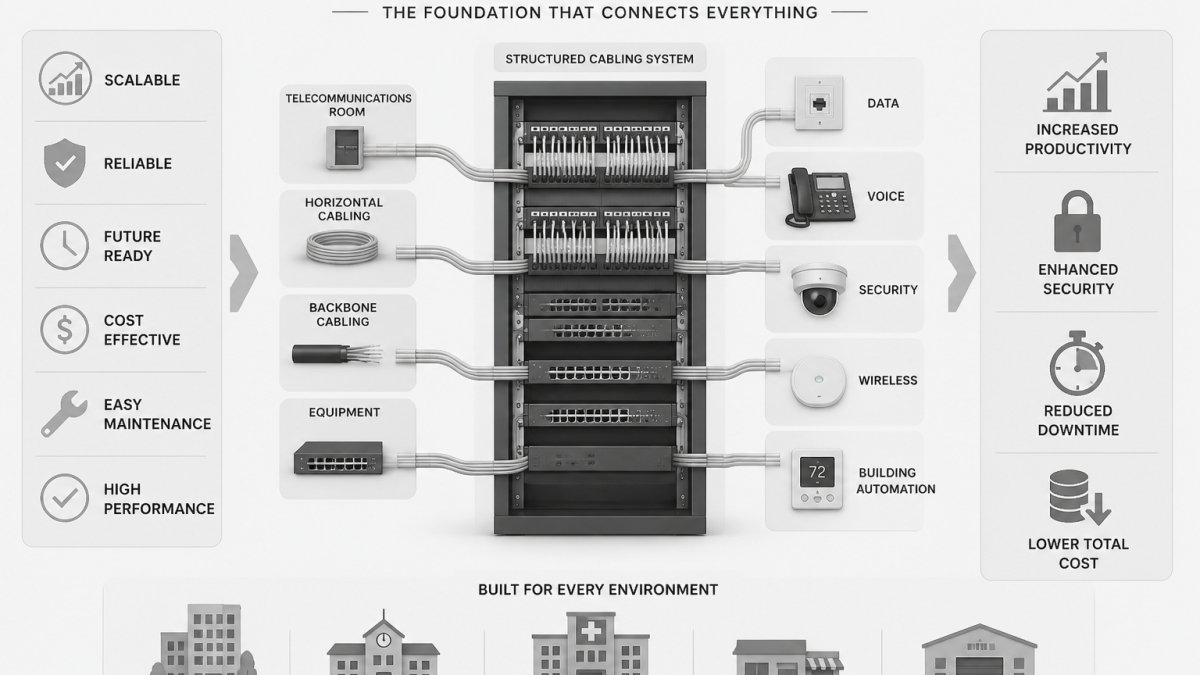
The two terms overlap in daily use, but they describe different scopes. Network cabling is the physical media, the copper and fiber that carry signals. Structured cabling is the whole system: cabling, jacks, patch panels, pathways, labeling, testing, and documentation, installed to a recognized standard so any run can be identified, tested, and replaced.
When the Terms Overlap and When They Don’t
A single Ethernet run to a printer is network cabling. A building-wide backbone with horizontal runs to every office, a labeled patch panel in a locked closet, and test results on file is structured cabling. When we bid a project, the distinction matters because it sets expectations: are we pulling one cable, or are we building infrastructure that has to serve the next ten years of hardware upgrades and network expansion? For most commercial sites, the second answer is the one that protects the budget.
Key Benefits: Reliability, Scalability, and Lower Maintenance Costs
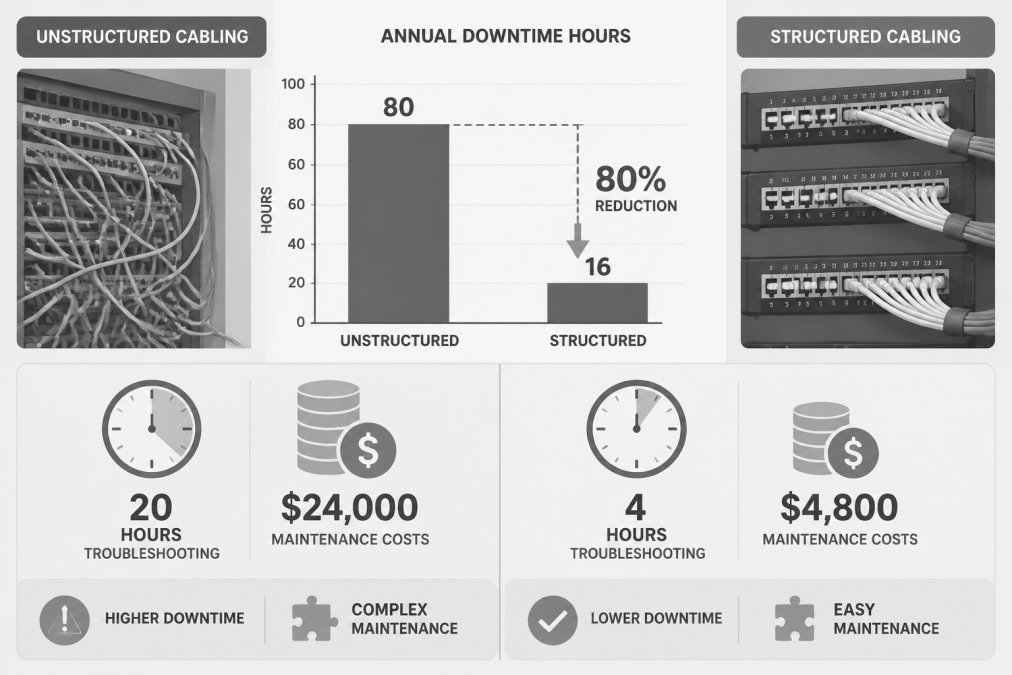
The core payoff is simple: a documented cabling system fails less often and costs less to fix when it does. Because every run is tested and labeled, technicians resolve issues without guesswork, and new devices plug into known-good ports instead of untested ones.
Benefit-by-Benefit: What Each One Actually Buys You
Reliability. A certified link either passes or fails its test, so marginal runs get fixed before they carry production traffic.
Lower maintenance cost. Troubleshooting time is the hidden line item.
Scalability. Adding a desk, camera, or access point becomes a patching exercise instead of a construction project.
Predictability. A structured system behaves the same way at 9 a.m. as it does at 2 p.m.
How Structured Cabling Reduces Downtime and Improves Network Performance
Damaged copper, a run stretched past its limit, or a cheap patch cable can cap bandwidth below what the plan delivers. When every link is certified, you get the maximum bandwidth the hardware supports, uninterrupted service during peak hours, and a network that behaves predictably.
Downtime reduction works through three mechanisms:
- Faster fault isolation. Labeled runs and as-built documentation cut the time between “something is down” and “we found the bad link.”
- Fewer self-inflicted failures. Consistent bend radius, termination, and pathway standards prevent the marginal links that fail only under peak load.
- Cleaner change management. Moves and adds are planned against a known map instead of improvised, so a new device does not destabilize an existing one.
Ask for test results per run, not just a “passed” summary. A certified link report tells you which specific jacks are marginal, so you can fix them before they fail.
Planning for Future Growth and Technology Upgrades
Scalability is where structured cabling pays for itself. Adding desks, cameras, access points, or a VoIP system becomes a matter of patching into an existing panel rather than opening walls. The TIA-568 commercial cabling standards overview give a useful baseline for how much headroom a well-planned system should carry.
A practical planning rule: size the backbone for the bandwidth you expect in five years, not the bandwidth you use today.
Reliability, maintenance savings, and scalability are not separate benefits, they compound. A documented system that fails less often is also cheaper to maintain and easier to expand.
Fiber Optic Cabling for Businesses: When It Makes Sense
Fiber optic cabling for businesses makes sense when distance, bandwidth, or electrical interference rules out copper. Fiber carries data farther without signal loss, is immune to the electromagnetic noise common in industrial settings, and handles the backbone traffic between buildings, floors, and server rooms.
Copper still wins for short horizontal runs to desks and cameras because it is cheaper and powers devices directly. The practical split most facilities land on: fiber for the backbone, copper for the edge.
| Cabling Type | Best For | Key Strength | Main Limitation |
|---|---|---|---|
| Fiber optic | Backbones, long runs, noisy environments | Distance and bandwidth | Higher material cost |
| Copper Ethernet | Desks, cameras, access points | Low cost, powers devices | Shorter runs, interference |
Structured Cabling Standards: What to Look for in an Installation
Structured cabling standards exist so a system works the same way whether it was installed this year or five years ago. Insist that your installer follows recognized commercial cabling standards for pathways, bend radius, termination, and testing. Standards compliance is not paperwork; it is what makes the system serviceable by someone other than the person who installed it.
Certification, Testing, and Documentation
Ask three questions before signing off on any installation:
- Was every run tested with a certified tester, with results provided?
- Is every cable, jack, and panel labeled to a consistent scheme?
- Did you receive as-built documentation showing where every run terminates?
If the answer to any of these is no, you are inheriting a future troubleshooting bill. Documentation is the single most valuable deliverable of a structured cabling project, and it is the first thing cut-rate installers skip.
Skipping certification testing to save time means marginal links stay hidden until peak load exposes them. The consequence is intermittent outages that are nearly impossible to diagnose after the fact.
Structured Cabling Maintenance: Keeping Your Network Healthy
Structured cabling maintenance is mostly prevention: keep closets clean and locked, never coil excess cable into tight bends, and re-test after any construction, move, or hardware change.
A simple annual walkthrough catches most of it. Check patch panels for strain, confirm labels still match, and verify that spare ports remain functional. Pairing it with a Managed IT Services agreement keeps monitoring, patching, and physical infrastructure under one point of accountability.
What Oregon Businesses Should Consider Before Upgrading
Regional conditions shape cabling decisions more than most owners expect. Older buildings common in many commercial districts were wired for telephones, not data, and may lack adequate pathways or closet space. Seismic bracing requirements matter for racks and overhead cable trays. In the Willamette Valley, seasonal humidity and temperature swings can stress older cable jackets, and agricultural or industrial sites deal with dust, moisture, and vibration that demand ruggedized pathways and enclosures.
Cost Drivers and Lifecycle ROI
The visible results for this topic rarely give cost guidance, so here is the honest version: structured cabling is priced per drop, and the per-drop number is driven by a handful of variables, not a flat rate.
- Building age and construction type. Open ceiling and accessible pathways are cheaper than finished ceilings, masonry, or occupied spaces that require after-hours work.
- Run count and run length. More drops and longer horizontal runs increase both material and labor.
- Pathway and closet work. New conduit, trays, or a dedicated telecom room can rival the cabling cost itself.
- Cable category and media. Higher-category copper and fiber cost more in material but may reduce future re-pulls.
- Testing, labeling, and documentation. These are labor hours, and they are the first thing cut-rate bids omit.
The ROI case is not the cable, it is the avoided cost. Fewer troubleshooting hours, fewer emergency after-hours repairs, and fewer disruptive re-pulls when the business grows. Frame the decision as a lifecycle cost over the years the system will serve, not a one-time purchase price.
Assessing What You Already Have
Before pricing anything, walk the site and answer four questions:
- What does the business actually run today, and what will it add in three years?
- Where are the bottlenecks: backbone, edge, or wireless coverage?
- What pathways and closet space already exist, and what has to be built?
- What is the budget, and how do we phase the work to fit it?
A simple inventory helps: count active drops, note the cable category printed on the jacket, check whether patch panels are labeled, and confirm whether any test results exist on file. If labels and documentation are missing, assume the existing plant is unverified and plan accordingly.
Phasing a Migration Without Disrupting Operations
Most businesses cannot shut down for a full re-cable. A phased approach keeps the lights on:
- Stabilize first. Fix or replace known-bad links and label the existing panels so the current network is at least serviceable.
- Build the backbone. Pull fiber and establish the main distribution frame before touching edge runs.
- Migrate by zone. Convert one area at a time, a floor, a department, a building, so disruption stays contained.
- Cut over after hours. Schedule the actual switch to new runs outside business hours, with a rollback plan if a link fails testing.
- Document as you go. Update as-built records at each phase so the final handoff is complete.
Costs vary widely by building age, square footage, and run count, so pricing depends on a site walk rather than a flat rate. A veteran-owned, Oregon-based team like Advanced Commercial Communications provides free site walks and consultations, which is the right first step before committing to a scope. We also coordinate cameras, access control, and paging into the same cabling plan so you are not paying twice for pathways.
Phasing without documentation defeats the purpose. If each phase is not recorded, the next contractor inherits the same unlabeled mess you started with.
The cheapest cabling decision is the one made once, with spare capacity and documentation built in. Retrofit work almost always costs more than planning ahead.
Frequently Asked Questions
Is structured cabling the same as network cabling?
They overlap but aren’t identical. Network cabling is any wiring that connects devices to a network. Structured cabling is a standardized approach to organizing that wiring into a planned system with defined pathways, patch panels, and labeling. All structured cabling is network cabling, but not all network cabling is structured. For Oregon businesses, structured cabling means your network wiring follows industry standards, which makes troubleshooting, maintenance, and future upgrades far easier.
How can structured cabling make a business network easier to maintain?
A structured cabling system uses labeled patch panels, organized cable runs, and documented pathways. When something goes wrong, technicians can trace connections quickly instead of guessing which unmarked cable leads where. This reduces troubleshooting time, minimizes downtime, and makes moves, adds, and changes faster. For facilities managers in Oregon, that translates to fewer emergency calls and lower ongoing maintenance costs.
Can structured cabling support future business growth?
Yes. A well-designed structured cabling system includes spare capacity and follows standards that support higher speeds as technology evolves. If your business adds staff, expands to new rooms, or upgrades to faster Ethernet or fiber optic cabling, the existing infrastructure can often handle it with minimal disruption. Planning for growth during installation costs less than retrofitting later, especially in commercial buildings where walls and ceilings are already finished.
What should businesses consider when choosing a structured cabling installer?
Look for experience with commercial installation, knowledge of structured cabling standards, and a track record of testing and documentation. Ask whether they provide free site walks, how they handle cable management, and what post-installation support they offer. For Oregon businesses, a local installer familiar with state building codes and common facility types can be a practical advantage. Request references and confirm they carry proper licensing and insurance.
Aging wiring, growing device counts, and buildings that were never designed for modern data traffic will eventually force the issue. Advanced Commercial Communications is a veteran-owned, Oregon-based provider of structured cabling, fiber optics, security camera systems, and managed IT, with free site walks and consultations to tailor a solution to your facility and budget. Get started with Advanced Commercial Communications and build a network that stays reliable as your business grows.