Table of Contents
- Why Fiber Optics Matter for School Connectivity
- Fiber vs. Copper Cabling for Schools
- Speed and Bandwidth: Supporting Hundreds of Connected Devices
- Reliability and Low Latency for Real-Time Learning
- Fiber Optic Cabling for Campus Networks
- School Network Infrastructure Upgrades: Planning for Growth
- Security, Safety, and Long-Term Value
- Frequently Asked Questions
Last Updated: October 11, 2026
Why Fiber Optics Matter for School Connectivity
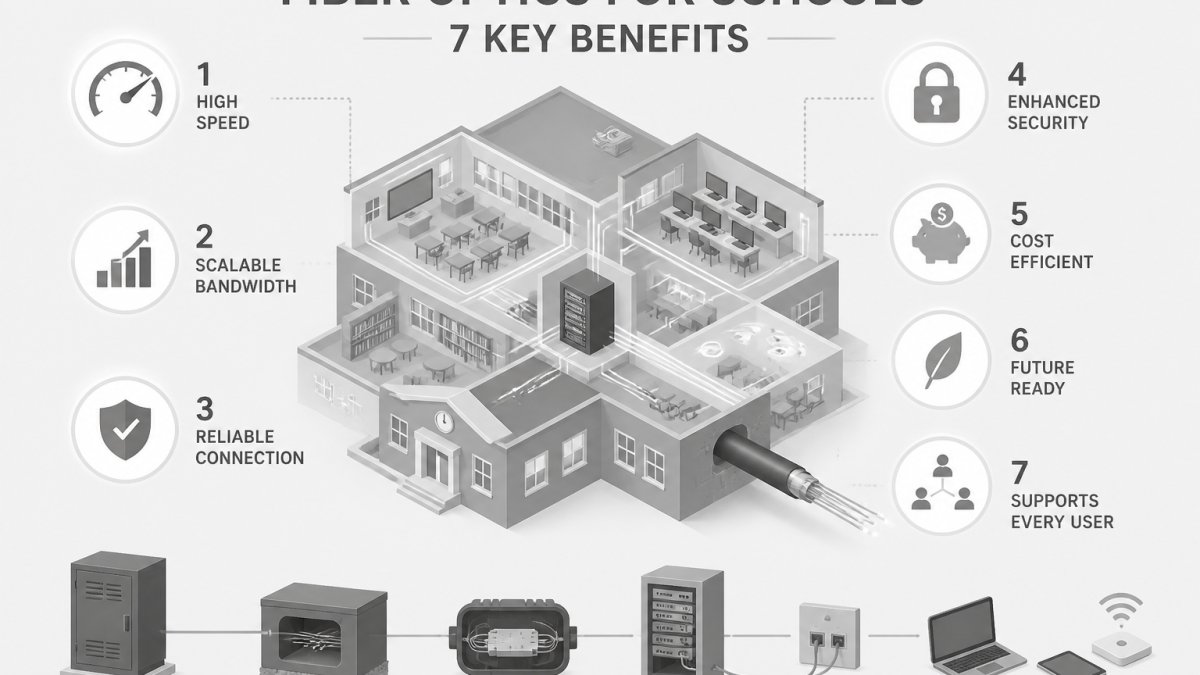
Fiber optics schools deliver data at light speed through glass strands, enabling schools to support hundreds of connected devices simultaneously without performance degradation.
Schools today manage security cameras, smartboards, student tablets, wireless access points, and administrative systems, all competing for bandwidth. A slow network disrupts lessons and delays emergency communications. Fiber optics solves this by providing virtually unlimited bandwidth capacity.
Advanced Commercial Communications delivers customized low-voltage and network infrastructure solutions to schools. We specialize in structured cabling, fiber optics, security camera systems, and managed IT, ensuring enhanced connectivity, operational efficiency, and improved safety through quality installation, economy, hard work, and integrity.
Fiber vs. Copper Cabling for Schools
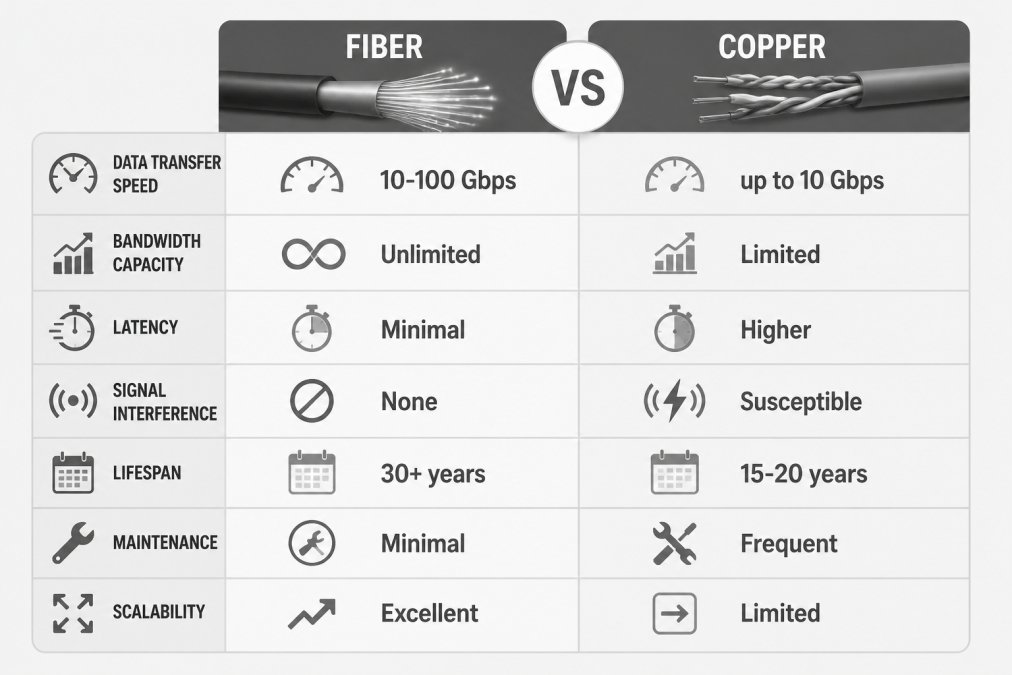
Fiber optics outperforms copper across every metric that matters for modern education.
Copper transmits data as electrical signals, but suffers from electromagnetic interference and distance limitations. Signal strength diminishes over longer runs, requiring expensive repeaters. For large campuses, these constraints add up quickly.
Fiber optic cabling uses light pulses, making it immune to electromagnetic interference. Data travels farther without degradation, and a single fiber strand carries more information than multiple copper pairs combined.
Fiber advantages:
- Carries data at light speed with no signal loss over distance
- Immune to electromagnetic interference from electrical equipment
- Supports higher bandwidth with lower latency
- Lasts 30+ years with minimal maintenance
- Scales easily as school technology demands grow
Copper limitations:
- Susceptible to interference from power lines and wireless equipment
- Signal degrades over distance, requiring expensive repeaters
- Limited bandwidth capacity for modern school networks
- Requires more frequent maintenance and replacement
- Difficult to expand without major reinstallation costs
For schools with multiple buildings and outdoor cameras, fiber eliminates interference problems. Long-term maintenance costs for copper often exceed fiber’s upfront investment.
When evaluating cabling upgrades, request a site assessment from a qualified installer. They can identify electromagnetic interference issues on your campus and recommend the right fiber solution for your specific layout and future growth plans. Advanced Commercial Communications offers free site walks to help you understand your current infrastructure and upgrade options.
Speed and Bandwidth: Supporting Hundreds of Connected Devices
Modern schools have smartboards, student devices, digital catalogs, enrollment systems, security cameras, and outdoor Wi-Fi access points, all competing for bandwidth.
When a school’s network cannot keep up, video conferencing lags, learning platforms buffer, and teachers lose instructional time.
Fiber optic internet provides the bandwidth capacity schools need. A single fiber connection delivers gigabit speeds to multiple buildings, allowing hundreds of students to stream videos, access learning platforms, and upload assignments without congestion.
During peak usage (9-11 a.m.), copper networks often choke while fiber systems maintain consistent performance due to higher underlying capacity.
Fiber optics schools solve the bandwidth problem that limits copper networks. A single fiber connection delivers more capacity than multiple copper lines combined, and that capacity scales with your school’s growth.
Reliability and Low Latency for Real-Time Learning
Network reliability is critical in education. Outages stop learning, disable video conferencing and attendance systems, and prevent emergency notifications.
Fiber optic cabling is inherently more reliable than copper. It has no moving parts, requires minimal maintenance, and can operate for decades without degradation.
Low latency is critical for interactive learning. Video calls require latency below 150 milliseconds; online testing and interactive whiteboards depend on real-time synchronization.
Copper networks introduce latency through signal processing and distance limitations. Fiber eliminates these delays, delivering responsiveness for video conferencing, collaborative platforms, and live streaming.
Fiber connections experience fewer outages than copper and recover faster, enabling higher uptime guarantees.
Fiber Optic Cabling for Campus Networks
A well-designed fiber backbone connects all school buildings to your internet service provider. The specifics depend on campus layout, existing infrastructure, and budget.
Fiber Topology Options for Schools
Most schools use one of three approaches:
Star topology connects all buildings to a central hub. This design is straightforward but creates a single point of failure. Star topology works well for small districts with 3-5 clustered buildings.
Ring topology loops fiber through all buildings. If one link fails, data reroutes automatically without interruption. Ring topology provides built-in redundancy for larger campuses where uptime is critical.
Mesh topology connects multiple buildings with redundant paths, offering highest reliability but requiring the most fiber cabling. It is typically reserved for large districts where cost is justified by scale.
Single-Mode vs. Multi-Mode Fiber
Single-mode fiber carries data farther with less signal loss and supports higher speeds (10-100 Gbps). It is the standard for long-distance runs between buildings.
Multi-mode fiber works well for shorter distances within buildings (up to 300 feet) and is less expensive than single-mode.
Hybrid Cabling Inside Buildings
A practical approach combines fiber backbone with copper patch cables at the device level. Fiber runs through building conduits to wall outlets; copper Ethernet cables connect devices.
Installation Disruption and Phasing
Fiber installation requires running cables through conduits, which may involve drilling or trenching. Schedule work during summer or winter breaks to minimize classroom disruption.
Phased installation spreads work across multiple years. Upgrade the main hub first, then add fiber to classroom buildings over subsequent summers. This realizes benefits immediately while managing costs.
Assessing Your Campus for Fiber Readiness
Before planning a fiber upgrade, conduct a site assessment to identify existing conduit, cable runs, and obstacles. Key questions: How many buildings need connectivity? Do existing conduits have space for fiber?
A qualified installer can assess your campus and recommend the topology and phasing approach that fits your constraints and budget.
Fiber optics cannot be tapped without breaking the signal, immediately alerting administrators to unauthorized access. Copper networks are vulnerable to wiretapping.
When evaluating fiber deployment, request a detailed site assessment from a qualified installer. They can identify conduit availability, estimate installation costs, recommend the right topology for your campus layout, and help you develop a phased rollout plan that fits your budget and minimizes disruption to classes.
School Network Infrastructure Upgrades: Planning for Growth
Network infrastructure upgrades require planning to demonstrate value to school boards. The most successful fiber deployments connect improvements to measurable outcomes that matter to educators and administrators.
Quantifying the Business Case: From Network Performance to Learning Outcomes
Before upgrading, establish baseline metrics to demonstrate practical impact on teaching and learning:
- Connectivity downtime: How many hours per month does your network experience outages or significant slowdowns? Calculate the instructional time lost and the cost of IT staff troubleshooting.
- Device connectivity failures: How many student devices fail to connect to Wi-Fi during a typical school day? This directly affects classroom technology use.
- Video conferencing quality: Do video calls drop or lag during peak hours? This impacts remote learning, guest lectures, and virtual field trips.
- Learning platform access: How long does it take for students to access online learning platforms during peak usage? Slow access discourages use and reduces engagement.
- File transfer and assignment submission: How long do students wait to upload assignments or access shared files? Delays frustrate users and reduce productivity.
Capacity Planning: Assessing Current and Future Bandwidth Needs
Audit current network usage with your IT department. Identify peak usage periods (most schools peak 9-11 a.m.), bandwidth per device (streaming video: 2-5 Mbps; learning platforms: 1-2 Mbps), connected device count, and future growth projections.
Example: 500 students and 100 staff with video streaming (5 Mbps × 600 devices = 3 Gbps) requires 4.5 Gbps with 50% headroom. Copper networks max out at 1-2 Gbps; fiber delivers 10-100 Gbps.
Funding and Budget Planning
Multiple funding sources exist: E-rate program (FCC discounts of 20-90% on broadband and equipment), state broadband grants, local bonds and capital budgets, public-private partnerships with ISPs, and phased budgeting across 3-5 years.
Timing and Coordination
Plan fiber installation during construction or major renovation projects. Adding fiber during a building project costs 30-50% less than retrofitting later.
Coordinate with IT staff, facilities, and instructional leaders to identify priorities. Classroom buildings with high technology use and poor current connectivity should be prioritized. Administrative buildings and technology hubs should be upgraded early to serve as the backbone for the rest of the campus.
Assessing Existing Infrastructure
Before committing to fiber, understand what you have:
- What is the age and condition of your current cabling? Copper installed 15+ years ago may be near the end of its lifespan and due for replacement anyway.
- Do you have existing conduit that can accommodate fiber, or will new conduit need to be installed? Existing conduit saves significant cost.
- Are there bottlenecks in your current network? Identify which buildings or departments experience the worst connectivity and prioritize them for fiber upgrades.
- What is your current internet service provider’s capacity and reliability? Fiber cabling is only valuable if your ISP can deliver sufficient bandwidth. Confirm that your ISP can support gigabit or multi-gigabit speeds before committing to fiber infrastructure.
The strongest fiber business case connects network improvements to measurable outcomes: reduced downtime, faster access to learning platforms, and improved classroom technology reliability. Quantify these benefits, explore E-rate and state funding programs, and phase the project to spread costs across multiple budget cycles.
Security, Safety, and Long-Term Value
Fiber optics for schools provides security benefits beyond network performance. Fiber connections cannot be tapped without breaking the signal. Copper networks are vulnerable to unauthorized access. For schools handling student records, grades, and personal information, fiber’s security advantage matters.
Safety is another consideration. Fiber cabling contains no copper, so it has no electrical hazard. In wet environments like pools or outdoor areas, fiber is safer than copper. Schools with athletic facilities, outdoor learning spaces, or areas near water benefit from fiber’s safety profile.
Long-term value extends beyond technical performance. Fiber infrastructure is future-proof. As data demands grow and new technologies emerge, fiber capacity scales to meet those needs. Copper networks eventually max out, requiring complete replacement. Schools that install fiber today avoid the expense and disruption of another major upgrade for decades.
The financial case is strong. Fiber’s durability means fewer replacement cycles. Lower maintenance requirements reduce IT staff burden. Improved network reliability reduces downtime costs. When you factor in these benefits over 30 years, fiber’s total cost of ownership is lower than copper despite higher upfront costs.
School networks must support modern learning. Fiber optics for schools delivers the speed, reliability, and scalability that education demands. If your school is experiencing network bottlenecks, struggling with connectivity issues, or planning infrastructure upgrades, fiber is worth serious consideration. Advanced Commercial Communications helps school districts across the region design and install fiber networks tailored to their specific needs. Contact us for a free site assessment to explore how fiber optics can improve your school’s connectivity and support your long-term technology goals.
Frequently Asked Questions
What are the main advantages of fiber optics for schools?
Fiber optics deliver significantly faster data transfer speeds, support thousands of simultaneous users without degradation, and offer near-zero latency for video conferencing and interactive lessons. Unlike copper lines, fiber is immune to electromagnetic interference, ensuring consistent connection quality. Schools also benefit from future scalability, fiber infrastructure can support expanding technology needs for years without replacement, making it a long-term investment in campus connectivity.
How does fiber optic cabling for campus networks compare to traditional copper?
Fiber optic cabling transmits data as light signals through glass strands, achieving speeds up to 100 times faster than copper while carrying far more bandwidth over longer distances without signal degradation. Copper is susceptible to electromagnetic interference from power lines and wireless equipment, which can cause bit errors and connection drops. Fiber also has a longer lifespan, requires less maintenance, and scales more efficiently as schools add devices and online resources to their networks.
Why should schools consider fiber optic internet for video conferencing and streaming?
Fiber’s low latency and high bandwidth eliminate the lag and buffering that plague video calls and multimedia lessons on slower connections. Students and teachers experience smooth, real-time interaction during remote and hybrid learning sessions. High-speed upload and download capabilities also mean large files, educational videos, interactive content, and digital resources, transfer instantly, reducing frustration and keeping lessons on schedule.
What should schools know about upgrading to fiber optic cabling?
School network infrastructure upgrades to fiber require planning around campus layout, existing conduit, and future growth. Fiber deployment costs depend on quantity of cable, building accessibility, and installation complexity. Work with experienced installers who conduct free site walks to assess your specific needs and budget constraints. Proper installation ensures maximum uptime and reliability. Consider how fiber integrates with your security cameras, Wi-Fi access points, and other connected systems for a cohesive campus network.